Inglês sobre Palmas: frases com tradução
Atualizado em 21 de setembro de 2026
Palmas é a capital mais nova do Brasil, projetada do zero e entregue em 1990. Quem mora aqui quase nunca precisa de inglês na rua, mas precisa na hora de explicar a um estrangeiro o que é capim dourado, por que a praça é tão grande ou o que se faz num fim de semana no Jalapão.
São 73 frases em inglês, cada uma com o que significa e onde usar. Elas não foram escritas para esta página: são as mesmas das dez missões de Palmas, Tocantins dentro do PROPRIUS, e estão aqui em texto para quem quiser só ler.
Os cinco lugares, em inglês
Frases prontas para descrever cada lugar, do jeito que um guia diria.
Capim Dourado Shopping
Capim Dourado Shopping is the largest shopping mall in Palmas! Its name is a tribute to the famous golden grass (capim dourado) of Jalapão.
Ponte de Palmas
The Fernando Henrique Cardoso Bridge is about 8 km long, crossing the Tocantins River and connecting Palmas to the district of Luzimangues.
Praia da Graciosa
Graciosa Beach is the most famous freshwater beach in Palmas, offering a beautiful sunset over the Lake of Palmas.
Parque Cesamar
Cesamar Park is the "lungs" of Palmas, famous for its running tracks, lakes, and the friendly capybaras that live freely there.
Catedral de Palmas
The Metropolitan Cathedral of Palmas features modern and grand architecture, located in the famous Praça dos Girassóis.
As frases, por situação
Hello Palmas!
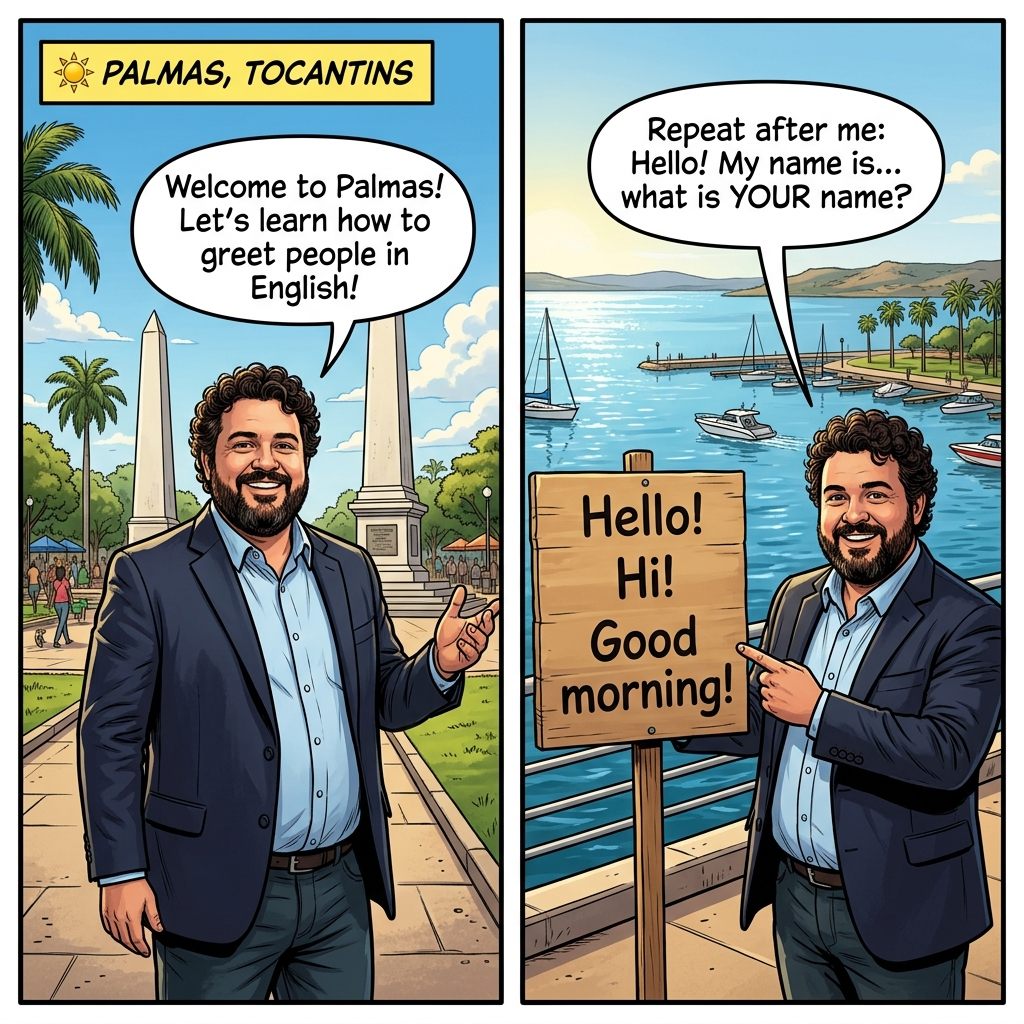
It is so hot today!'It is so hot today' = 'Está muito quente hoje'.
Hello! How are you doing today?'Hello' é a saudação universal!
Good morning!Good morning = Bom dia.
My name is Marcelo.'My name is...' = 'Meu nome é...'
A Cidade Desenhada
Palmas was planned by architects before anyone lived here.Voz passiva com 'by': 'was planned by architects' = foi planejada por arquitetos.
Palmas is a city whose streets are numbered instead of named.'Whose' = cujo, cuja. Liga a rua à cidade sem repetir a palavra.
The city was founded in 1989 and it is still growing.'Was founded' = foi fundada. Voz passiva, porque quem fundou não importa aqui.
It was designed by architects who had never built a capital before.Voz passiva: sujeito + was + particípio + by + quem fez.
Água de Coco na Graciosa
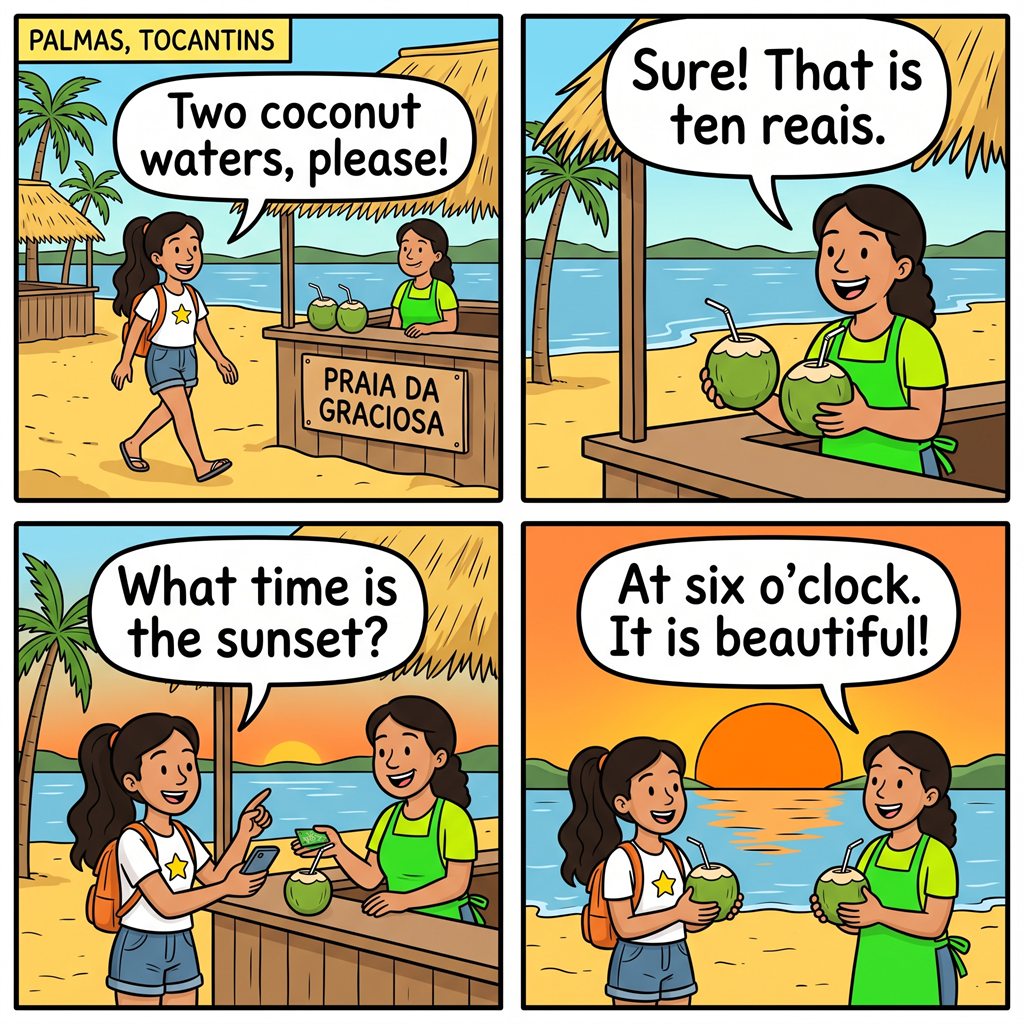
Sure! That is ten reais.'That is ten reais' = 'São dez reais'. Ten = 10.
The bridge is eight kilometers long.Eight = 8.
Where are you from?'Where are you from?' = 'De onde você é?'
One, two, three!1, 2 e 3 em inglês. O 'th' de three tem som soprado, com a língua nos dentes.
Negócio na Praia
Would you give me a better price if I bought two of them?Condicional: 'would... if I bought' é o jeito educado de negociar.
I have been coming here for years and the coconut is always cold.Presente perfeito contínuo: começou no passado e continua até hoje.
I have tried this before and I liked it very much.'Have tried' = já experimentei. Presente perfeito, sem dizer quando.
Could you recommend something that is not too sweet?'Could you' é mais educado que 'can you' num pedido a um desconhecido.
Rumo à Praça dos Girassóis
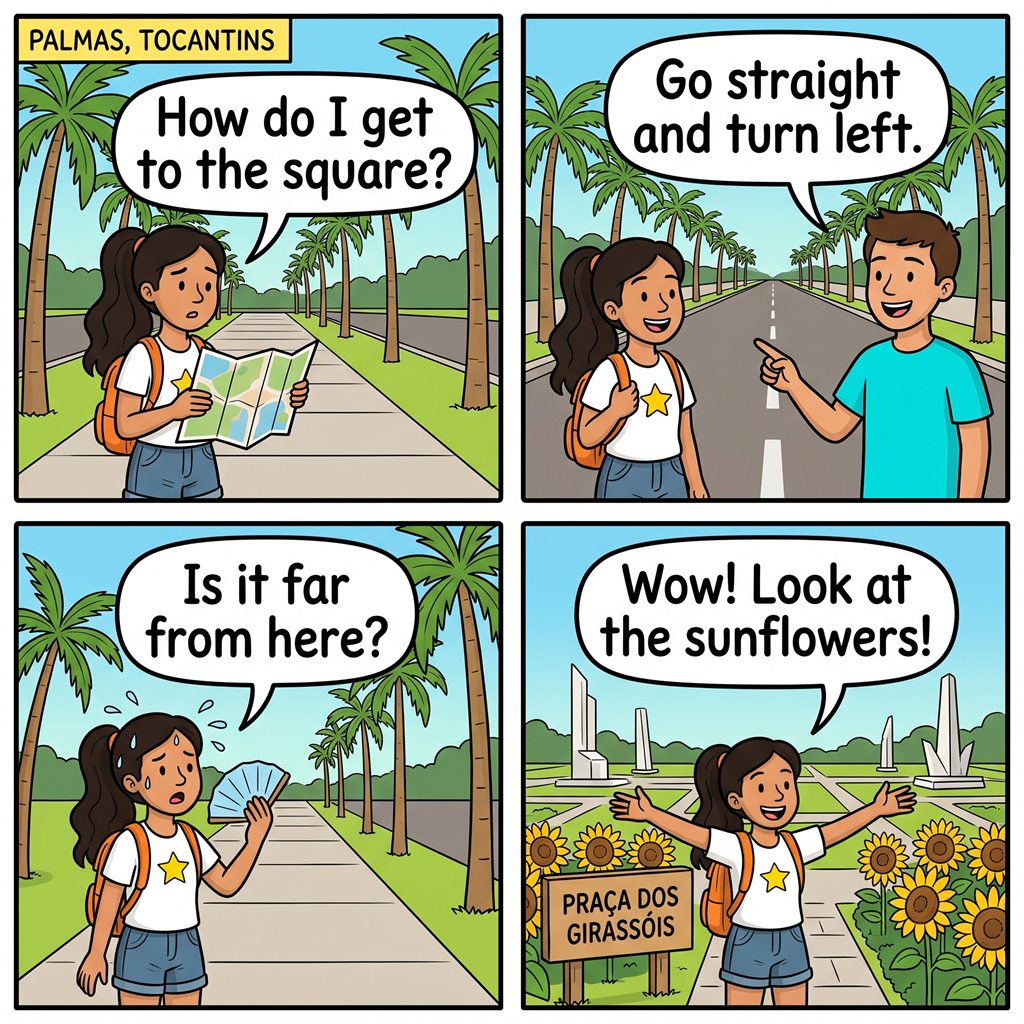
Go straight and turn left.'Go straight' = siga em frente. 'Turn left' = vire à esquerda.
How do I get to the square?'How do I get to...?' = como eu chego a...?
Where is Sunflower Square?Pergunta curta e clara, que funciona em qualquer esquina.
The lake is ten minutes by car.'By car' = de carro. 'On foot' = a pé.
Explicando o Caminho
If you follow this avenue you will reach the square in ten minutes.Condicional dá instrução clara: 'if you follow... you will reach'.
Because of the heat, most people walk early in the morning.'Because of' vem antes de substantivo; 'because' vem antes de frase.
Turn right at the second traffic light and go straight ahead.'Traffic light' = semáforo. 'Second' = segundo.
This is the street which is numbered two hundred and ten.'Which' liga a descrição ao objeto, sem repetir a palavra 'street'.
Tucunaré à Beira do Lago
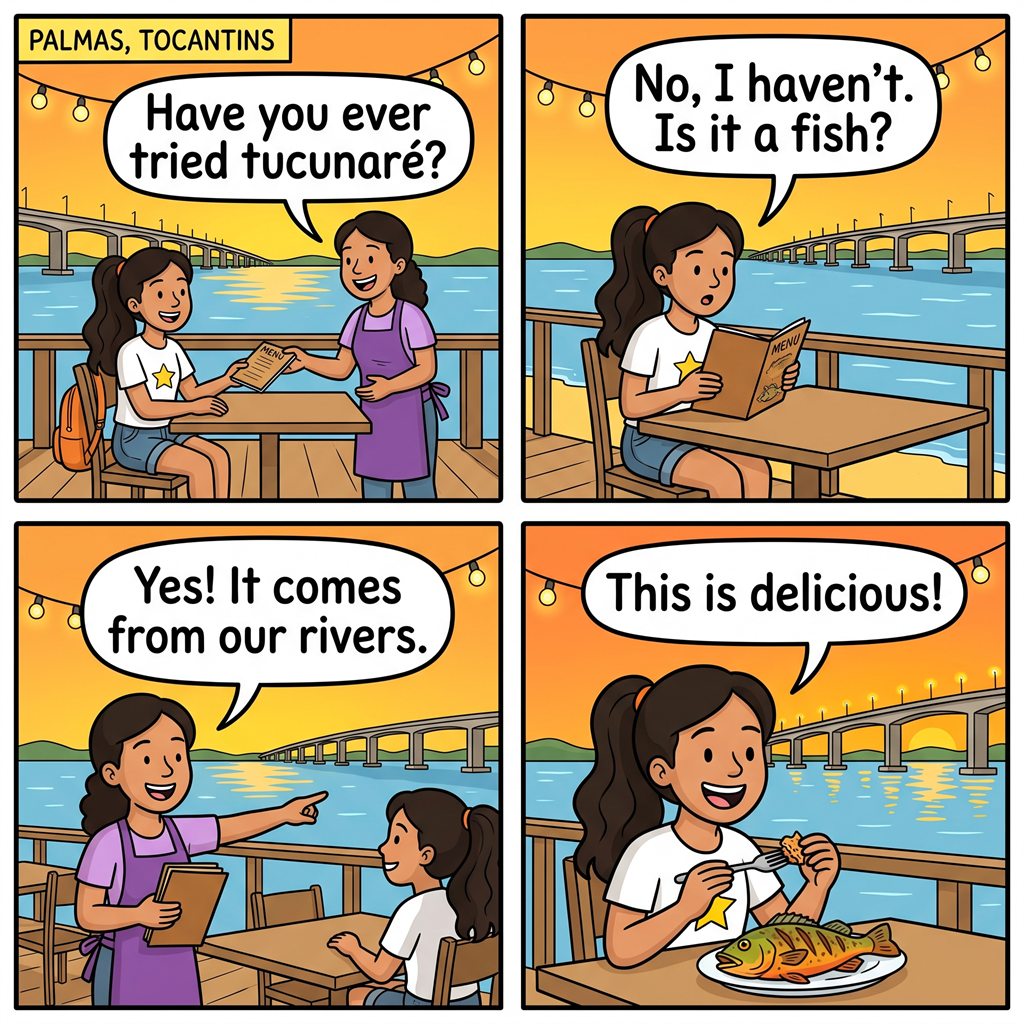
Have you ever tried tucunaré?'Have you ever tried...?' = você já provou...? É o present perfect, usado para as experiências da vida.
I would like the fish, please.'I would like' é o jeito educado de pedir.
Could I see the menu, please?'Menu' = cardápio.
The fish comes with rice and farofa.'Comes with' = vem com, acompanha.
Capim Dourado
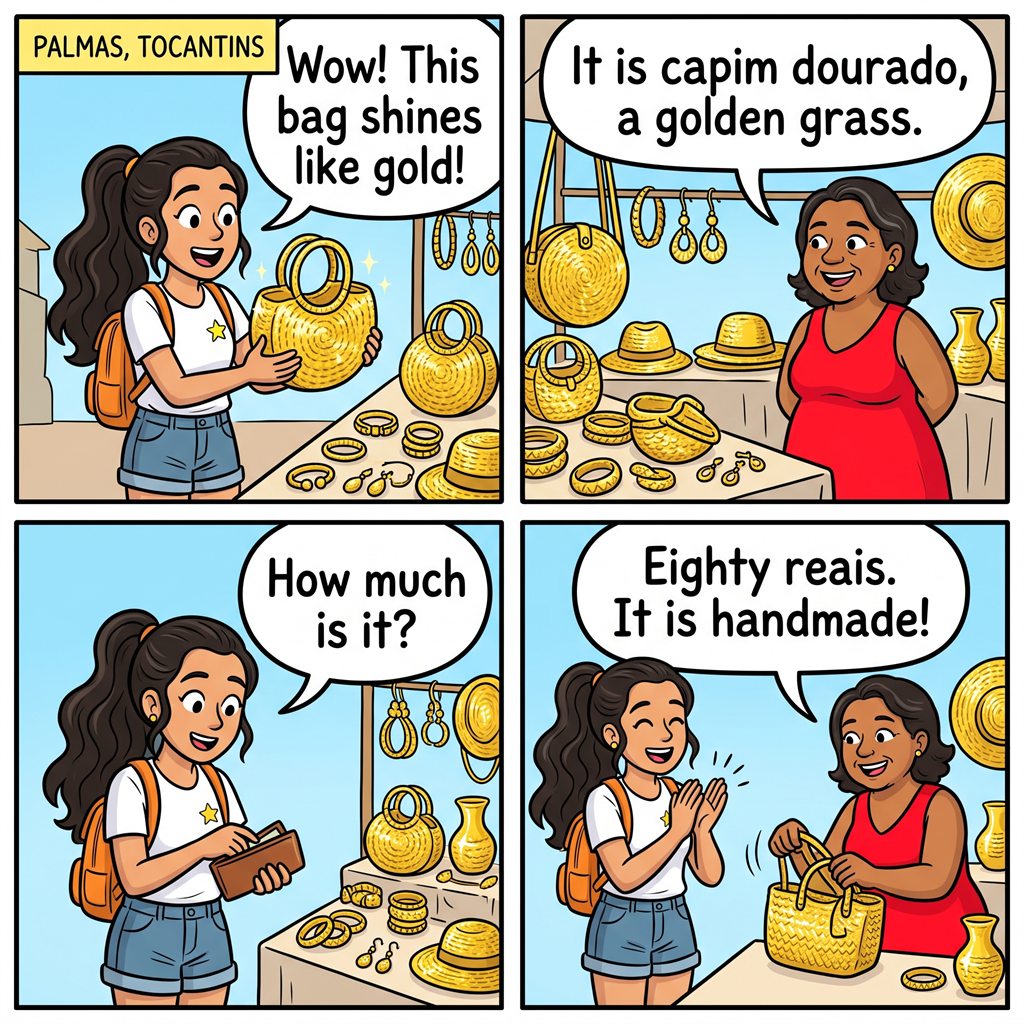
It is capim dourado, a golden grass.'Golden grass' = capim dourado. 'Grass' é capim, grama.
It is handmade.'Handmade' = feito à mão: hand (mão) + made (feito).
It shines like gold!'Shine' = brilhar. 'Gold' = ouro.
It is eighty reais.'Eighty' = 80. 'Eighteen' = 18.
O Capim que Virou Patrimônio
Every piece is made by local artisans who learned from their mothers.Voz passiva com 'by': o foco é a peça, e não quem a fez.
It is a plant whose roots are protected by federal law.'Whose' liga a planta às raízes dela numa frase só.
This is made by hand and it takes several days.'By hand' = à mão. Note o 'by' outra vez.
It is protected by law because it almost disappeared.Passiva completa: sujeito + is + particípio + by + agente.
Show na Praça
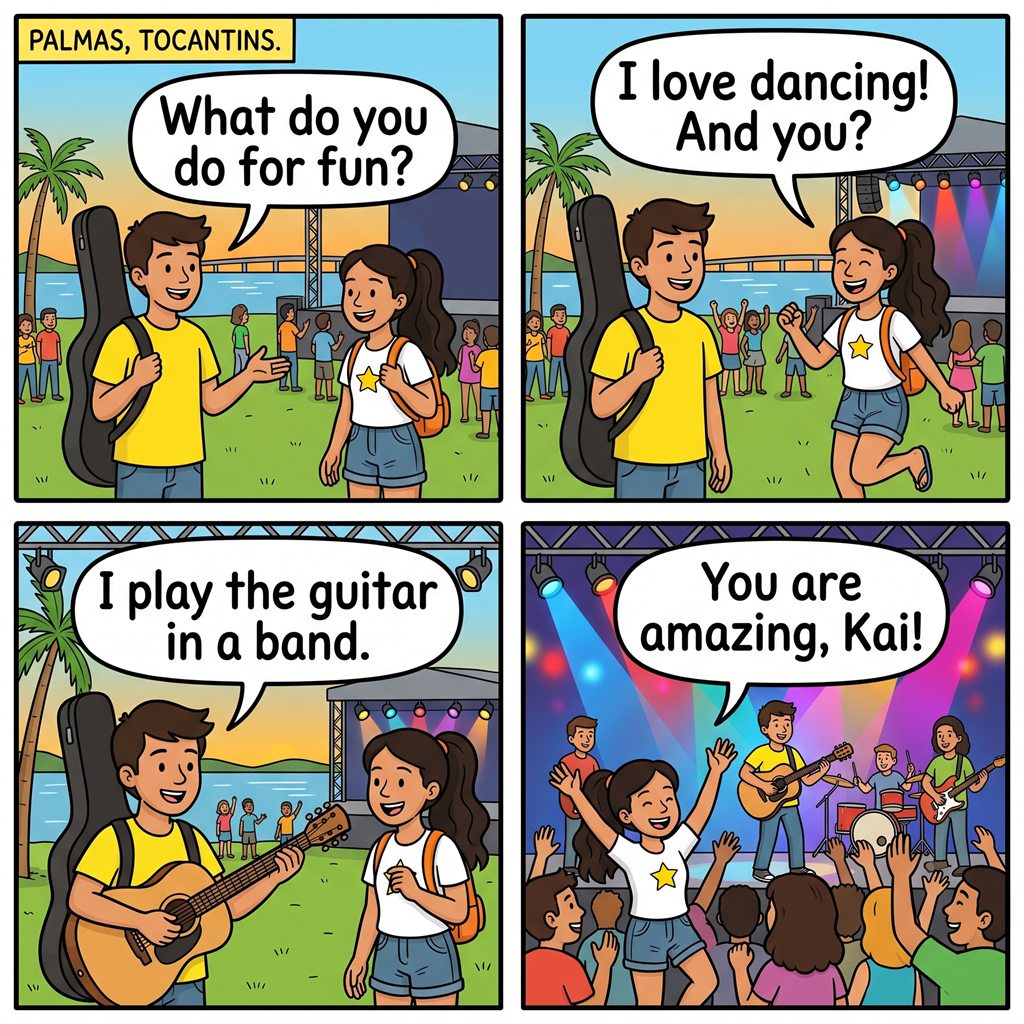
I play the guitar in a band.'I play the guitar' = eu toco violão. 'Band' = banda.
What do you do for fun?'For fun' = por diversão, para se divertir.
I love dancing!Depois de 'love', o verbo pode vir com -ing: dancing.
The show in the square is free.'Free' aqui = de graça, gratuito.
Depois do Show
The show has just finished and the square is still full.'Has just finished' = acabou de terminar. Presente perfeito com 'just'.
I have been listening to this band for years and they keep improving.Presente perfeito contínuo: começou antes e continua.
I have never heard this song before tonight.'Heard' é o particípio de 'hear'. Irregular.
The band which played last was the best of the night.'Which' liga a descrição à banda sem repetir a palavra.
Rumo ao Jalapão
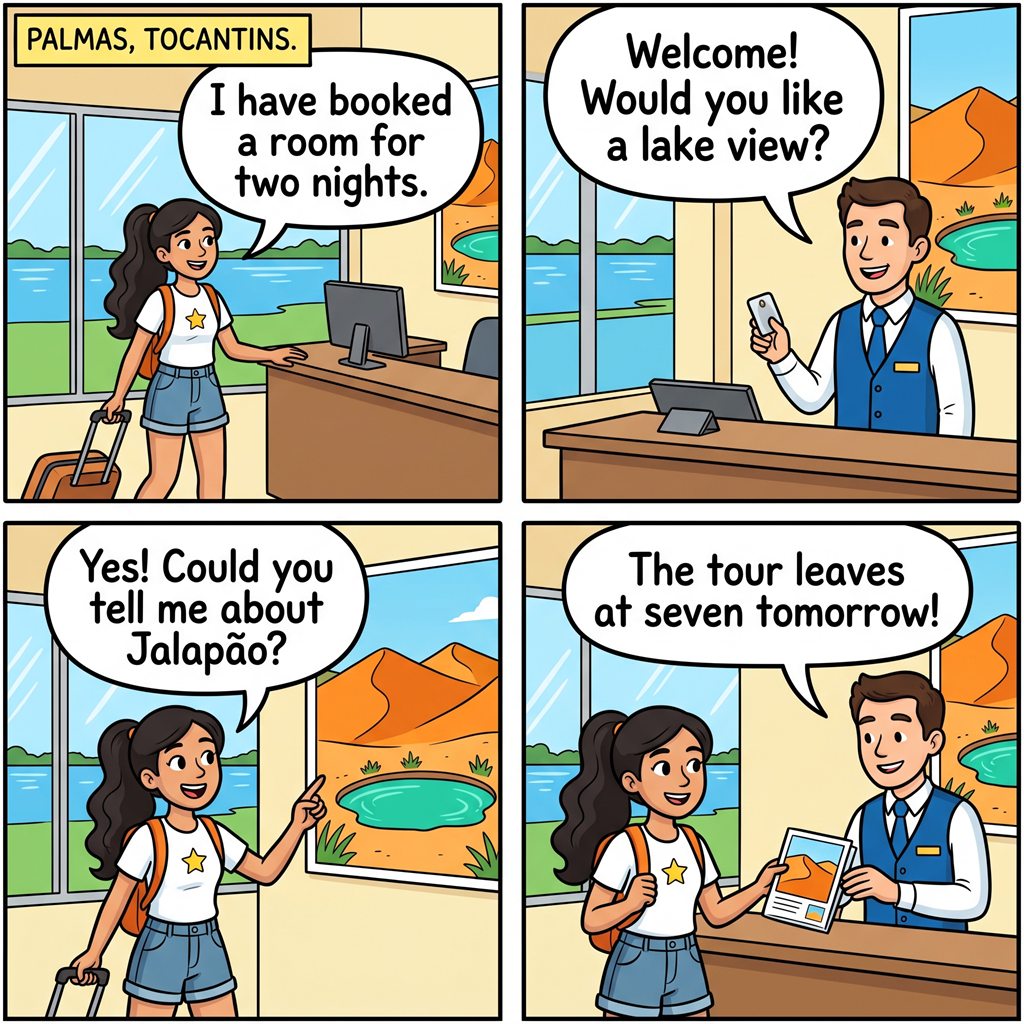
Could you tell me about Jalapão?'Could you tell me about...?' = você poderia me contar sobre...?
Would you like a lake view?'Would you like...?' = você gostaria de...?
I have booked a room.'Book' = reservar. 'I have booked' = eu reservei, e a reserva vale agora.
The tour leaves at seven tomorrow.'Leaves' = sai, parte. 'Tomorrow' = amanhã.
Calor no Cesamar
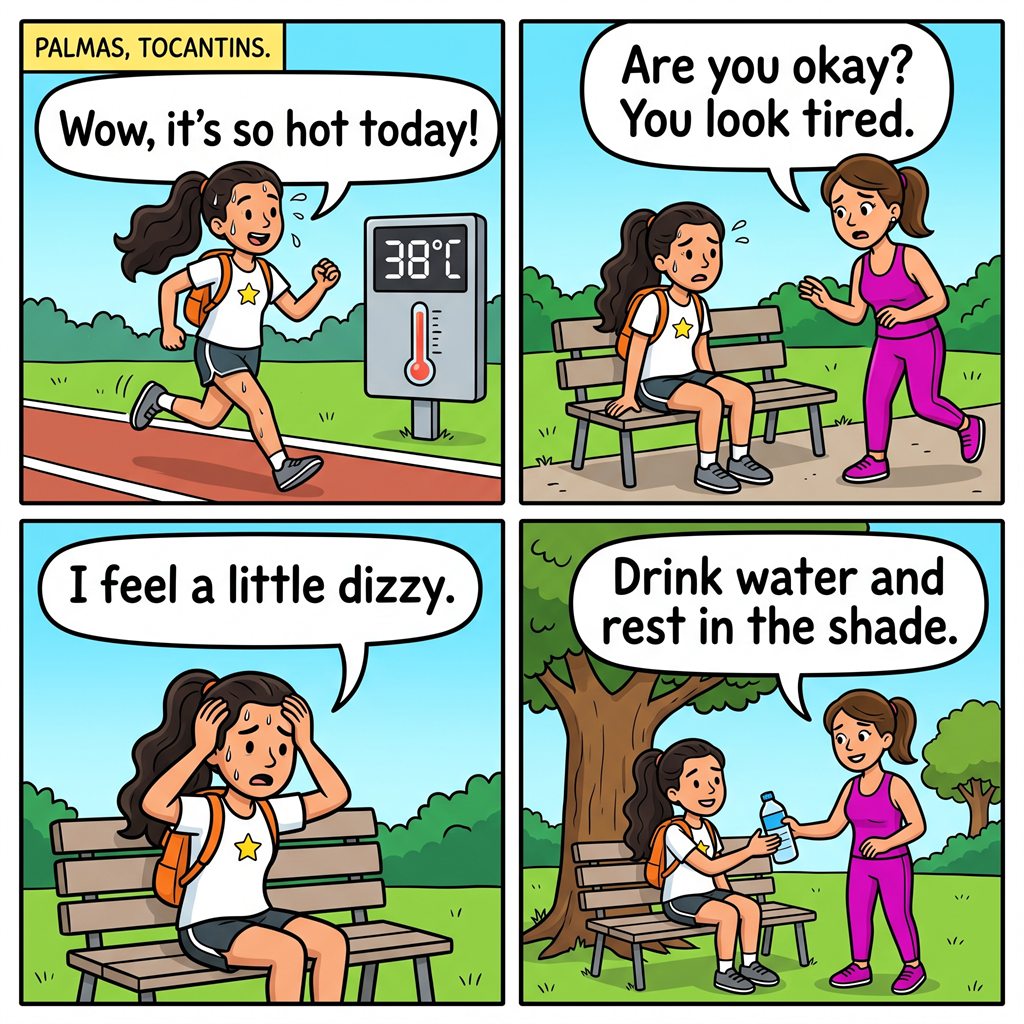
Drink water and rest in the shade.'Drink water' = beba água. 'Rest in the shade' = descanse na sombra.
I feel a little dizzy.'Dizzy' = tonto. 'A little' = um pouco.
I need some water.'Some water' = um pouco de água.
Are you okay? You look tired.'You look tired' = você parece cansado.
O Calor de Palmas
You should drink water even if you are not thirsty yet.'Should' é o conselho; 'even if' cobre o caso improvável.
Despite the shade, the afternoon here is extremely hot.'Despite' = apesar de, e vem antes de substantivo.
I need some shade now before I get a headache.'Shade' = sombra de proteção. 'Shadow' é a silhueta no chão.
The whole trail is covered by the sun until five in the afternoon.Voz passiva com 'by' descrevendo o lugar.
Celular Perdido na Graciosa
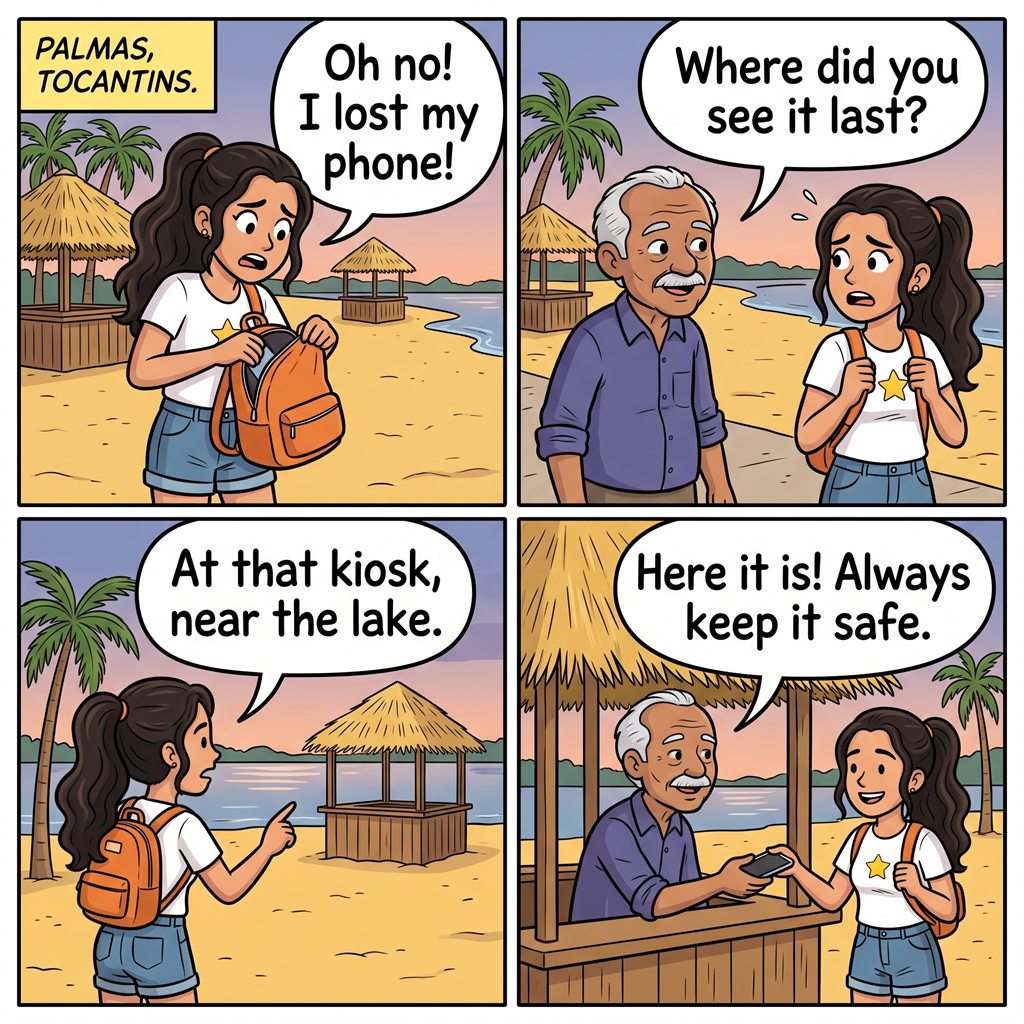
At that kiosk, near the lake.'Kiosk' = quiosque, como os da Praia da Graciosa. 'Near the lake' = perto do lago.
Help me, please!'Help me, please' = ajude-me, por favor.
Where did you see it last?'Last' aqui = pela última vez.
Oh no! I lost my phone!'Lost' = perdi, o passado de 'lose'.
Registrando a Ocorrência
My bag was taken while I was swimming in the lake.Passiva 'was taken' + 'while' + passado contínuo. É a estrutura do relato.
The man whom I saw near the kiosk had a blue backpack.'Whom' é o objeto: eu vi ELE. 'Who' seria o sujeito.
I need to file a report before I leave the city.'File a report' = registrar uma ocorrência. Expressão fixa.
He had already left by the time the guard arrived.'Had left' aconteceu antes de 'arrived'. A ordem importa no relato.
Para Onde Agora?
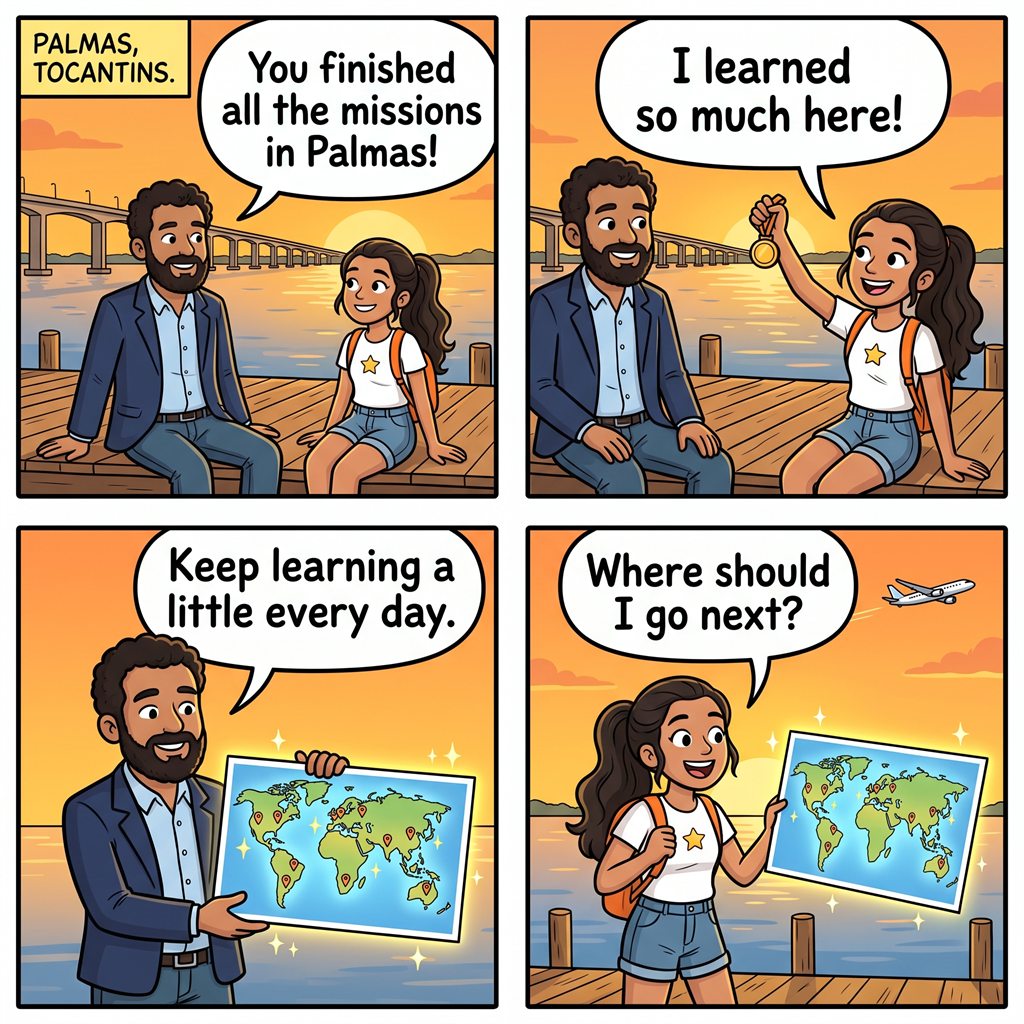
Keep learning a little every day.'Keep learning' = continue aprendendo. 'A little every day' = um pouco todo dia.
I learned so much here!'Learned' = aprendi. 'So much' = tanto.
Practice makes perfect.Um provérbio famoso, e verdadeiro.
You finished all the missions in Palmas!'Finished' = terminou. 'All the missions' = todas as missões.
Como praticar essas frases
Ler uma frase e reconhecê-la depois são coisas diferentes. Estas mesmas frases estão dentro do PROPRIUS como as dez missões de Palmas, Tocantins, com áudio, exercícios de montar a frase e correção na hora. O app é gratuito para as cidades brasileiras e não pede cartão.
Todas as cidades: inglês por cidade · Sobre o PROPRIUS · Contato · Privacidade