
Inglês sobre o Rio de Janeiro: frases com tradução
Atualizado em 21 de setembro de 2026
O Rio é a cidade brasileira que mais recebe estrangeiro, e é onde mais brasileiro é parado na rua para dar informação em inglês. As frases abaixo são as que resolvem essas conversas: como explicar onde fica o Cristo, quanto custa o bondinho, qual praia pega onda.
São 81 frases em inglês, cada uma com o que significa e onde usar. Elas não foram escritas para esta página: são as mesmas das dez missões de Rio de Janeiro, Brazil dentro do PROPRIUS, e estão aqui em texto para quem quiser só ler.
Os cinco lugares, em inglês
Frases prontas para descrever cada lugar, do jeito que um guia diria.
Sugarloaf Mountain
Sugarloaf Mountain got its name because its shape resembles the traditional loaf-shaped blocks of refined sugar.
Copacabana Beach
Copacabana Beach's sidewalk has a famous wave-patterned mosaic that stretches for about 4 kilometers.
Christ the Redeemer
Christ the Redeemer is one of the New Seven Wonders of the World and stands 30 meters tall on top of Corcovado Mountain.
Maracana Stadium
Maracana Stadium once held over 199,000 spectators for the 1950 World Cup final, one of the largest crowds in football history.
Selaron Steps
The Selaron Steps were created by Chilean artist Jorge Selaron, who covered them with over 2,000 colorful tiles from around the world.
As frases, por situação
Rio de Janeiro Adventure
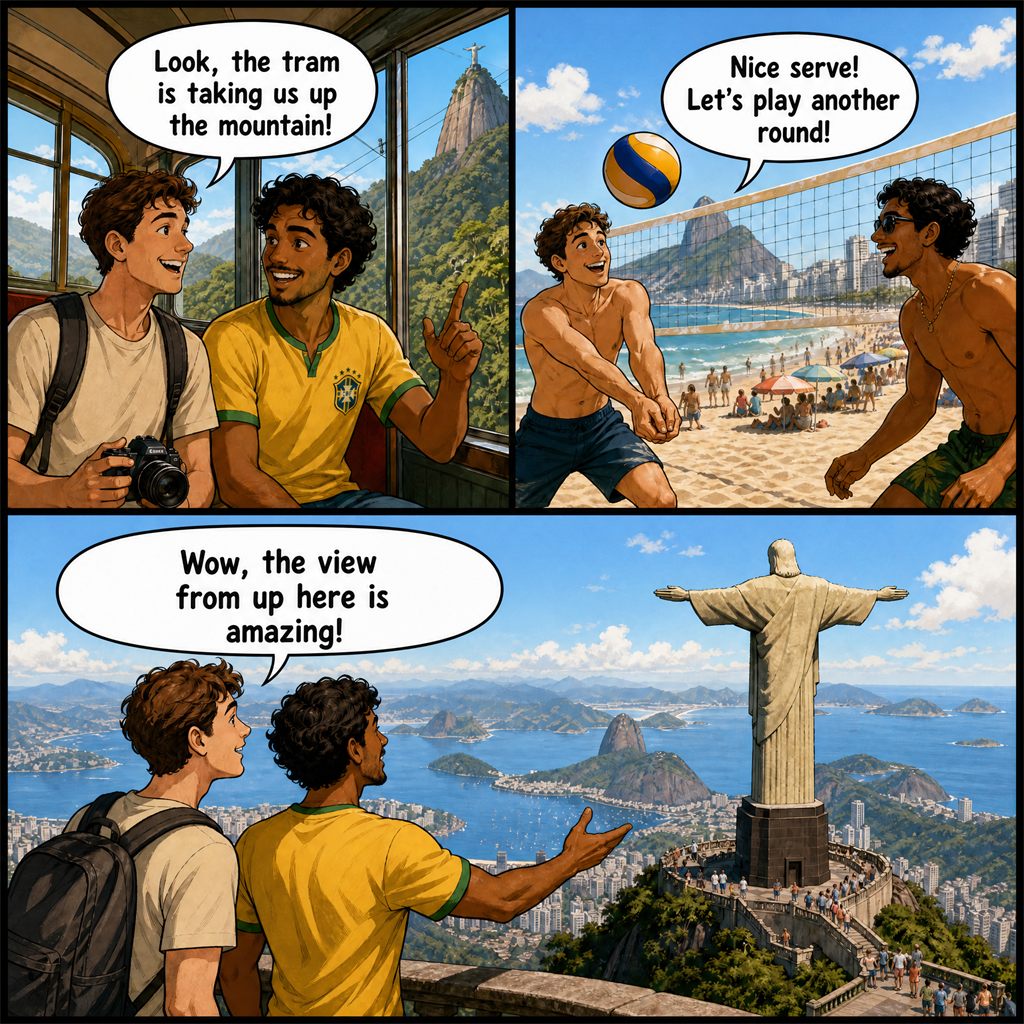
Wow, the view from up here is amazing!O Cristo Redentor é um dos ícones mais famosos do Brasil.
Let us go to the beach!Beach = praia.
This view is amazing!'Amazing' = incrível.
I love Rio de Janeiro!'I love' = 'Eu adoro'.
A Cidade Partida
The city was built between the sea and the mountains, with no room to spare.Passiva 'was built' com a localização depois.
There are neighbourhoods whose streets climb the hills for kilometres.'Whose' liga as ruas aos bairros.
The view from here is incredible at any hour of the day.'View from' = vista de. A preposição é 'from'.
It is surrounded by water on almost every side.Passiva com 'by': cercado por.
Beach Volleyball in Rio
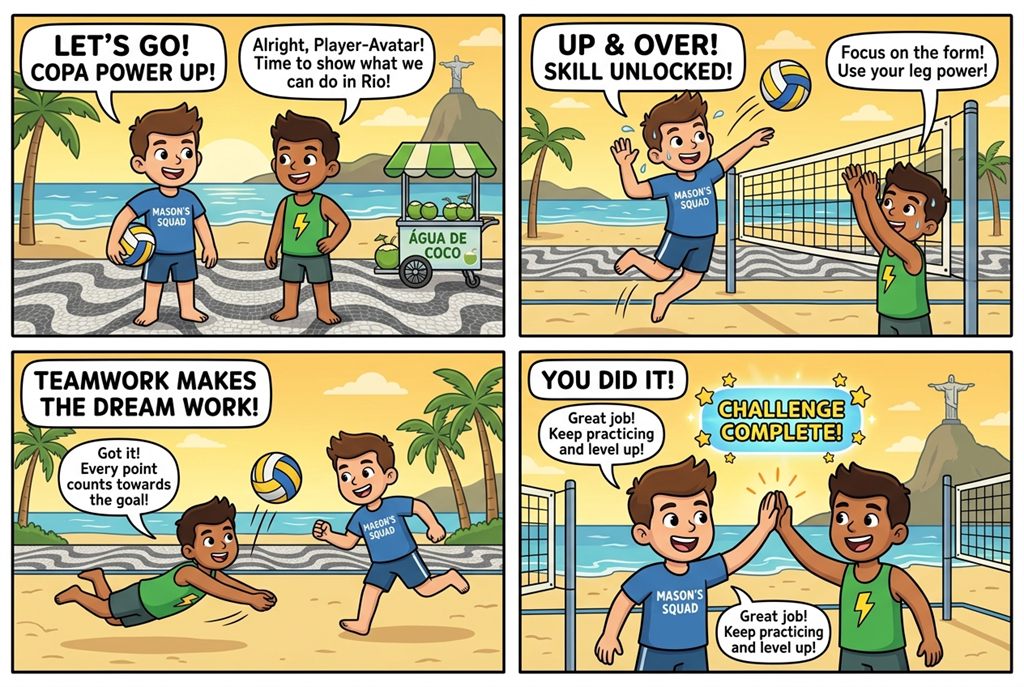
That's how we play in Rio!O Cristo Redentor aparece no alto do Morro do Corcovado, visivel de varios pontos do Rio, incluindo Copacabana.
The sidewalk has a wave pattern!A famosa calcada de Copacabana tem um padrao de ondas em mosaico que se estende por cerca de 4 km.
Watch out for my serve!Muito bem! 'Watch out' significa 'cuidado/preste atenção'.
Let's play?'Let's' e a contracao de 'Let us', usada para convidar alguém a fazer algo.
Regras Que Ninguém Escreveu
These rules are understood by everyone here but never written down.Passiva com 'by' para uma regra coletiva.
Every spot on the sand is a place which belongs to nobody.'Which' liga a descrição ao lugar.
Can I sit here or is this spot taken?'Is this taken' é a pergunta padrão para lugar ocupado.
It is rude to walk through a game without asking.'It is rude to' + verbo introduz a regra social.
Escadaria Selarón
This staircase has over two thousand tiles.'Staircase' = escadaria.
A Chilean artist named Jorge Selarón made it.Ele começou em 1990 e trabalhou nela até morrer.
Visitors sent tiles from more than sixty countries.Turistas de todo o mundo mandavam azulejos.
Every single step was handmade.'Handmade' = feito à mão.
O Chileno das Escadas
The two hundred and fifteen steps were covered by a single artist.Passiva com 'by' e o autor no fim.
They are tiles which came from more than sixty different countries.'Which' liga a origem aos azulejos.
It took him twenty years to finish the whole staircase.'It took him' = levou a ele. Estrutura fixa de duração.
It was never finished, because he kept changing the tiles.Passiva negativa: 'was never finished'.
Um jogo no Maracanã
The crowd here is the loudest in Brazil.'Crowd' = multidão/torcida.
He scored a goal in the last minute!'Score a goal' = marcar um gol.
The referee did not see the foul.'Referee' = juiz/árbitro.
Almost 200,000 people came here for the 1950 final.Foi uma das maiores multidões já reunidas num jogo.
O Silêncio de 1950
The stadium was built for the 1950 World Cup in less than two years.Passiva com finalidade: 'was built for'.
It was a defeat which is still remembered seventy years later.'Which' liga a descrição, e 'is remembered' é passiva.
The game starts at four and the gates open at two.'At' para hora exata.
The crowd went quiet and stayed quiet for a long time.'Go quiet' = ficar em silêncio. 'Go' aqui é virar, tornar-se.
O bondinho de Santa Teresa
The yellow tram runs through the whole neighborhood.'Tram' = bonde.
The tram crosses an eighteenth-century aqueduct.'Aqueduct' = aqueduto.
The cobblestone streets are steep and narrow.'Cobblestone' = paralelepípedo.
Santa Teresa is a neighborhood on a hill.'On a hill' = em cima de um morro.
O Bonde que Voltou
The tram was closed after a serious accident in 2011.Passiva 'was closed' com a causa depois.
It carries people whose houses are high on the hill.'Whose' liga as casas às pessoas.
How much is the ticket for a single ride?'Ticket' serve para passagem, ingresso e bilhete.
It came back after six years of pressure from the neighbourhood.'Came back' = voltou. 'After' marca o tempo passado.
Feijoada de sábado
Feijoada is a black bean stew with different cuts of meat.'Stew' = ensopado/cozido.
It's a heavy meal - most people nap afterwards.'Heavy meal' = refeição pesada.
It comes with rice, collard greens, farofa and orange slices.'Collard greens' = couve.
The whole family gathers around the table.'Gather around' = reunir-se em volta.
A Comida dos Sábados
It is traditionally eaten on Saturdays, and almost never at night.Passiva 'is eaten' para um costume coletivo.
It is a dish which takes many hours to cook properly.'Which' liga a característica ao prato.
I want to try a little before filling my plate.'A little' para quantidade incontável.
It is very heavy, so most people sleep afterwards.'Heavy' para comida = pesada.
Carnaval no Sambódromo
Each samba school has thousands of members.Apesar do nome, é uma agremiação comunitária, não uma escola de ensino.
The parade lasts about eighty minutes per school.'Parade' = desfile.
That float is four stories tall!'Float' = carro alegórico.
The drummers keep the beat for the whole parade.'Keep the beat' = manter o ritmo.
Um Ano para Uma Noite
The costumes are made throughout the whole year by hundreds of people.Passiva 'are made' com a duração depois.
Each is a school whose theme changes completely every year.'Whose' liga o enredo à escola.
The parade lasts eighty minutes and not one second more.'Last' como verbo = durar.
They rehearse all year for one single night.'Rehearse' = ensaiar. 'All year' fecha a frase.
Floresta da Tijuca
This forest was replanted by hand in the 1860s.'Replanted by hand' = replantada à mão.
There are monkeys in the trees above the trail.'Monkey' = macaco.
This trail leads to a small waterfall.'Trail' = trilha.
The area was deforested for coffee farms.'Deforested' = desmatado.
A Floresta Replantada
The forest was replanted by hand in the nineteenth century.Passiva 'was replanted' com o modo depois.
It replaced coffee farms which had destroyed the original forest.'Which had destroyed' junta relativo e mais-que-perfeito.
The city ran out of water and that is why they replanted.'Run out of' = ficar sem. Passado: ran out of.
It was planted by six men over more than a decade.Passiva com 'by' e quem fez depois.
Trilha da Pedra Bonita
The hike takes about forty minutes.'Hike' = caminhada em trilha.
I'm out of breath already!'Out of breath' = sem fôlego.
We're almost at the summit.'Summit' = cume/topo.
From up there you see the city, the forest and the ocean at once.'At once' = ao mesmo tempo.
De Onde Se Vê Tudo
It is harder than it looks, so bring more water than you think.Comparativo 'harder than' seguido de oração.
I have climbed it three times and the view still surprises me.Presente perfeito com número de vezes.
It takes an hour to climb if you do not stop.'It takes' + tempo + 'to' + verbo.
It is better to start early, before the sun gets strong.'It is better to' + verbo é o conselho impessoal.
Uma noite na Lapa
The arches were built as an aqueduct in the eighteenth century.'Arches' = arcos.
Every bar here has live music.'Live' aqui = ao vivo (pronuncia-se /laiv/).
By midnight the place was packed.'Packed' = lotado.
Everyone stands around the samba circle.'Circle' = roda (o formato em que os músicos tocam).
Como praticar essas frases
Ler uma frase e reconhecê-la depois são coisas diferentes. Estas mesmas frases estão dentro do PROPRIUS como as dez missões de Rio de Janeiro, Brazil, com áudio, exercícios de montar a frase e correção na hora. O app é gratuito para as cidades brasileiras e não pede cartão.
Todas as cidades: inglês por cidade · Sobre o PROPRIUS · Contato · Privacidade